Skip to content
  • Software Engineer
  • Coimbatore, India
  • Portfolio ©2026

Kavin Nandha M K, Software Engineer

I build backend systems, APIs and full-stack products — and ship them all the way to production.

Currently
Final-year B.E. CSE (Cyber Security)
Previously
SDE Intern, TeamMistake Technologies
Focus
Backend · Full-stack · Systems

In short

Coimbatore, India · Open to relocation

I work the whole request path — from the React component to the API, the auth layer, the data model, the cache and the container it ships in. I care less about which framework is on top and more about what is happening underneath the abstraction.

Concurrent users
2,500+
Sustained at peak on a bare-metal k3s platform I deployed
Shipping to production
6 mo
Node.js / Express features, MongoDB and JWT/RBAC at TeamMistake
Hackathon participants
350+
Won SRCAS 2.0 with Sentinel AI against a field of 350+
CGPA
8.67
B.E. Computer Science & Engineering (Cyber Security)
(01)Selected work

Systems I've designed, built and shipped.

  1. (01)Full-stack placement platform

    HR Connect

    Students, recruiters and administrators each get their own dashboard on one shared system. I designed the REST API and MongoDB data model, secured every route with JWT and role-based access control, and put a Redis cache in front of the hottest reads.

    Fig. 01 — Architecture
    HR Connect — architectureHTTPShot readswritesReact + TS3 role dashboardsNginxreverse proxyExpress APIJWT · RBACRediscache, invalidateon writeMongoDBpostings ·applications

    3

    user roles, one API

    • React
    • TypeScript
    • Node.js
    • Express
    • MongoDB
    • Redis
    • Docker
    • Nginx
    • REST API and MongoDB models for postings, applications and profiles
    • JWT authentication with RBAC enforced in the API — never trusted to the UI
    • Redis cache with invalidation on write to cut repeated database reads
    • Role-specific React + TypeScript dashboards, containerized with Docker behind Nginx
  2. (02)Distributed job scheduling2026

    Email Job Scheduler

    Campaigns come in over an API, land in Postgres, and fan out as one delayed BullMQ job per email. A separate worker process delivers them under per-sender rate limits that hold across any number of concurrent workers, and a boot reconciler rebuilds the whole schedule from Postgres if Redis loses its data.

    Fig. 02 — Architecture
    Email Job Scheduler — architecture1 txnenqueueduereconcileReact SPAdashboardExpress APIzod · sessionsPostgressystemof recordRedis ·BullMQdelayedjobs ·Lua limitsElasticsearchsearch indexWorkerBullMQ consumerSMTP · Slackdelivery · alerts

    0

    cron jobs — all delayed jobs

    • TypeScript
    • Node.js
    • Express
    • BullMQ
    • Redis
    • PostgreSQL
    • Elasticsearch
    • React
    • Docker
    • Deterministic job IDs, status guards and a guarded UPDATE stop double sends
    • Send slots and hourly limits enforced atomically in Redis Lua scripts
    • API and worker scale and restart independently; Redis AOF plus boot reconciliation survive restarts
    • Elasticsearch search with a Postgres fallback, Slack alerts on rate-limit hits
  3. (03)ML-integrated moderation backend2025

    Sentinel AI

    Winner — SRCAS 2.0 Hackathon, 350+ participants

    I built the REST APIs and the ingestion pipeline that feeds user posts to the classifier, then turned its verdicts into a moderation workflow — flag, escalate, report — with RBAC and an audit log around every action. It won SRCAS 2.0 and became a published paper.

    Fig. 03 — Architecture
    Sentinel AI — architectureclassifyverdictauditUser postsreal-time feedExpress APIingest · RBACML classifierharm scoreMongoDBposts · cases ·audit logModerationflag ·escalate · report

    1st

    of 350+ participants

    • Node.js
    • Express
    • MongoDB
    • ML integration
    • RBAC
    • Ingestion pipeline from user posts to an ML classifier, results in real time
    • Moderation workflow: flag, escalate and report harmful content
    • MongoDB schemas, RBAC and audit logging around every moderation action
    • Co-authored the research paper, published in JRANNS (April 2026)
  4. (04)Production platform at scale

    Moodle LMS on bare-metal k3s

    An entire institution's coursework, quizzes and automated code grading, running on hardware in the building rather than a managed cloud. I split the web tier and the grading workloads into isolated services, and wired in monitoring before go-live so resource decisions came from real metrics.

    Fig. 04 — Architecture
    Moodle LMS on bare-metal k3s — architecturegradescrape2,500+ usersstudents · staffIngressrouting · TLSMoodleweb tier podsCodeRunner ·Jobeisolated gradingMySQLPVC-backedPrometheus ·Grafanametrics first

    2,500+

    concurrent users at peak

    • Kubernetes (k3s)
    • Docker
    • MySQL
    • Prometheus
    • Grafana
    • Linux
    • Deployments, Secrets and PersistentVolumeClaims on dual Intel Xeon Gold 6430
    • CodeRunner/Jobe grading isolated from the web tier serving the pages
    • Prometheus, Grafana, cAdvisor and Node Exporter in place before the first class
    • Diagnosed networking, storage and resource contention from metrics and k8s logs
  5. (05)AI agent + evaluation harness2026

    ground-score

    The agent is deliberately small; the engineering is in proving it. A golden set, a cross-vendor judge validated against an independent annotator, fully cached reproducible runs, and honest reporting: intent accuracy beat the baselines, the auto-routing did not, and the write-up says so.

    Fig. 05 — Architecture
    ground-score — architectureevalCustomermessagesupport threadRulesnever-auto guardsRetrieve8.5k-thread corpusClassifyintentDraftgrounded replyRouteauto or humanJudgecross-vendor eval

    7 → 45

    draft defects without grounding

    • Python
    • RAG
    • Ollama
    • Gemini
    • Embeddings
    • Evaluation
    • Pipeline: rules → retrieve → classify → draft → route, rules before the model
    • Intent accuracy 0.667 on traffic-proportional dev vs. 0.314 for TF-IDF + LR (pooled)
    • Ablation: retrieval off took draft defects from 7 to 45
    • Reproducible from committed caches — a cache miss is a hard error, not a live call
More projects

Smaller builds, same habits.

(02)How I build

Follow one request through everything I build.

Most bugs live between components, not inside them. So I think about the whole path a request takes — and what each layer owes the next.
  1. Client

    React · TypeScript

    Role-aware interfaces and protected routes. The UI shows what you can do; it never decides what you are allowed to do.

    → GET /api/jobs?status=open (recruiter dashboard)
  2. Edge

    DNS · TLS · Nginx

    The name resolves, TLS terminates, and a reverse proxy hands the request to the right upstream.

    dns ✓ tls ✓ nginx → upstream api:4000
  3. Middleware

    Express · JWT · RBAC

    Validate every user-controlled input, verify the token, enforce the role. Authorization lives in the API.

    validate ✓ jwt ✓ rbac: role=recruiter ✓
  4. Service layer

    Business logic

    Routes stay thin. Services hold the rules, so the logic is testable and independent of any client.

    jobs.service.listOpen({ recruiterId })
  5. Cache

    Redis

    Hot reads come from cache and are invalidated on write — used where the read/write trade-off earns it, not everywhere.

    redis GET jobs:open → MISS → fill
  6. Data

    MongoDB · PostgreSQL · MySQL

    Schemas modelled on real query patterns. Indexes where they matter, and no redundant round trips on hot endpoints.

    db.jobs.find({ status: "open" }) ↳ index scan
  7. Ship

    Docker · GitHub Actions

    One container image, built and released by CI, so the thing I tested is the thing that runs.

    image api@sha-7f3c built and released by CI
  8. Observe

    Logs · Prometheus · Grafana

    Metrics in place before go-live, so capacity and debugging decisions come from data instead of guesses.

    http_requests_total{route="/api/jobs"} += 1
  9. ← 200 OK application/json

How does this entire system need to work, how will it fail, how will I observe it, and how will I secure it?
(03)Experience

Where I've shipped to production.

  1. 03.1

    Oct 2025 — Mar 2026

    Internship · 6 months

    TeamMistake Technologies

    SDE Intern

    Worked on the Admin Dashboard module — building its production Node.js / Express services end to end, from data modelling and API design to deployment and production debugging.

    • Owned backend features for the Admin Dashboard module end to end, from data modelling and API design to deployment.
    • Designed MongoDB schemas and rewrote queries to remove redundant database calls on high-traffic endpoints.
    • Built JWT authentication and role-based access control (RBAC) from scratch for user and admin workflows.
    • Containerized services with Docker, shipped releases through GitHub Actions CI/CD, and managed DNS and SSL/TLS.
    • Node.js
    • Express
    • MongoDB
    • JWT
    • Docker
    • GitHub Actions
    • Nginx
  2. 03.2

    Oct — Dec 2025

    Industrial training

    Intel Unnati Industrial Training

    Industrial Trainee

    Built a multilingual NCERT doubt-solving assistant on an OPEA-based retrieval-augmented generation pipeline.

    • Combined retrieval with an LLM so answers come from the textbook, not the model's general knowledge.
    • Supported questions and answers across multiple languages.
    • Python
    • OPEA
    • RAG
    • LLMs
(04)Stack

Tools I reach for, and why.

TypeScript, Node.js, Express, React, Next.js, Python, REST APIs, JWT / RBAC

MongoDB, PostgreSQL, Redis, BullMQ, Docker, Kubernetes, GitHub Actions, RAG

  • 01

    Languages

    What I think in

    • TypeScript
    • JavaScript
    • Python
    • SQL
    • Bash
  • 02

    Backend

    My strongest layer

    • Node.js
    • Express.js
    • REST API design
    • JWT / RBAC
    • Middleware & validation
    • BullMQ
  • 03

    Data

    Modelled on query patterns

    • MongoDB
    • PostgreSQL
    • MySQL
    • Redis
    • Schema design
    • Query optimization
  • 04

    Frontend

    Component-driven

    • React
    • Next.js
    • Tailwind CSS
    • React Native
    • Flutter
  • 05

    Ship & run

    From commit to production

    • Docker
    • Kubernetes (k3s)
    • GitHub Actions
    • AWS
    • Linux
    • Nginx
    • Git
  • 06

    AI engineering

    Grounded, measured

    • LLM APIs (Claude, OpenAI, Gemini)
    • RAG
    • Evaluation harnesses
  • 07

    Core CS

    The fundamentals

    • Data structures & algorithms
    • OOP
    • DBMS
    • Operating systems
    • Computer networks
(05)Recognition

Built under pressure, judged by others.

05.1Awards

  • 2026

    Samsung Solve for Tomorrow

    Top 5 Finalist · AI Living for India

    National innovation programme

  • 2025

    SRCAS 2.0 Hackathon

    Winner

    350+ participants · with Sentinel AI

  • 2025

    MobilityX 2.0 Hackathon

    Runner-up · Software Track Winner

    250+ participants · 24-hour build

  • 2026

    MAHE Mobility Challenge

    AI Track Finalist

    MIT Bengaluru

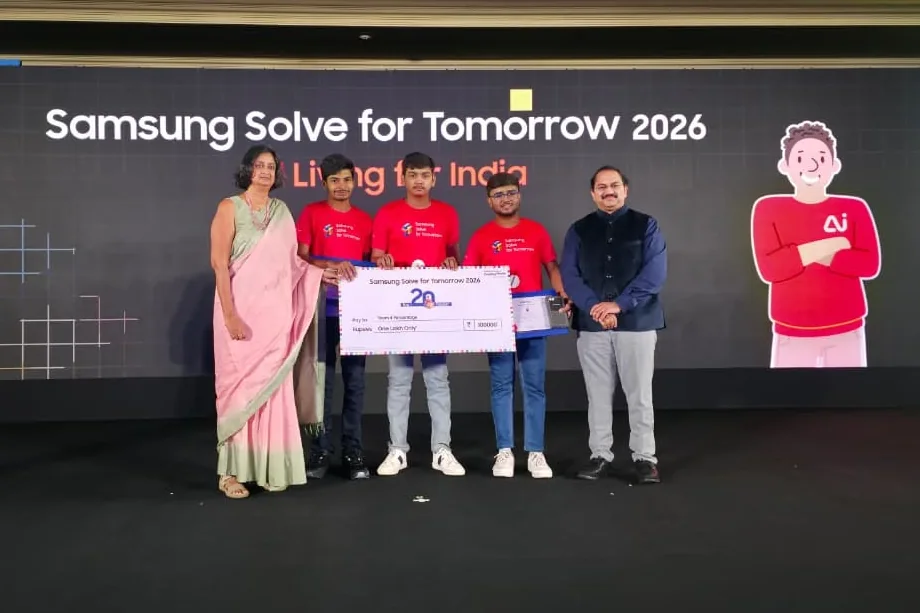
On stage at the Samsung Solve for Tomorrow 2026 grand finale, receiving the Top 5 finalist award
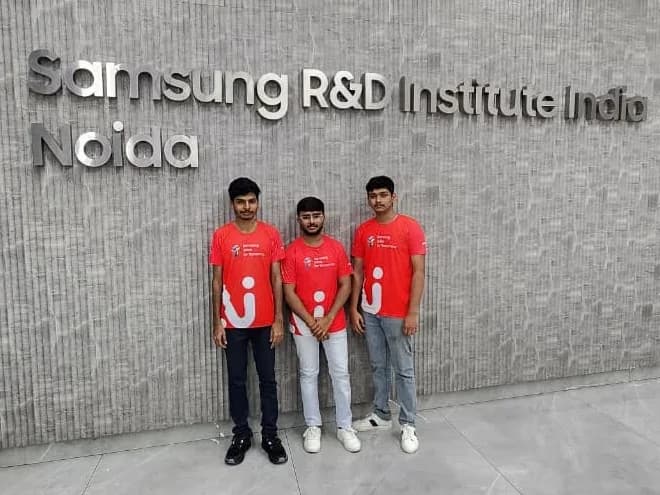
The team at Samsung R&D Institute India, Noida

Spotlight

Samsung Solve for Tomorrow 2026

Top 5 Finalist · AI Living for India

Grand finale · ₹1,00,000 award · Visited Samsung R&D Institute India, Noida

05.2publication

Journal of Research in Artificial Neural Network Systems (JRANNS)

Sentinel AI: Cyber Bully Detection and Prevention

Vol. 2, No. 2 · April 2026 · Co-author

05.3certifications

  • Anthropic

    2026

    Claude Code in Action

    Verify
  • AWS Skill Builder

    2026

    AWS Cloud Practitioner Essentials

  • Aspire Institute

    2026

    Aspire Leaders Program

  • Intel

    2025

    Intel Unnati Industrial Training

(06)About

Engineer by building, not just by studying.

Portrait of Kavin Nandha M K
Kavin Nandha M KCoimbatore, India

I'm a final-year Computer Science and Engineering (Cyber Security) student at Sri Shakthi Institute of Engineering and Technology, Coimbatore. Most of what I know came from building, deploying, breaking and fixing real systems.

I like owning a feature across every boundary: design the API, model the data, implement authentication, containerize it, deploy it, and then debug it when a user says something is wrong. A security background means I design access control in from the start instead of bolting it on.

I'm looking for a software engineering role where I can own work end to end and keep learning what happens underneath the abstraction.

Education

  1. 2023 — 2027

    B.E. Computer Science and Engineering (Cyber Security)

    Sri Shakthi Institute of Engineering and Technology, Coimbatore

    CGPA 8.67 / 10
  2. 2023

    Higher Secondary Certificate (HSC)

    VVM Matric Hr. Sec. School, Coimbatore

    83.4%
(07)Contact

Let's build something that holds up.